


Real Estate Taxes in Syria: Types, Fees, Exemptions, and Calculation Guide
2026-07-14
3,189 Views
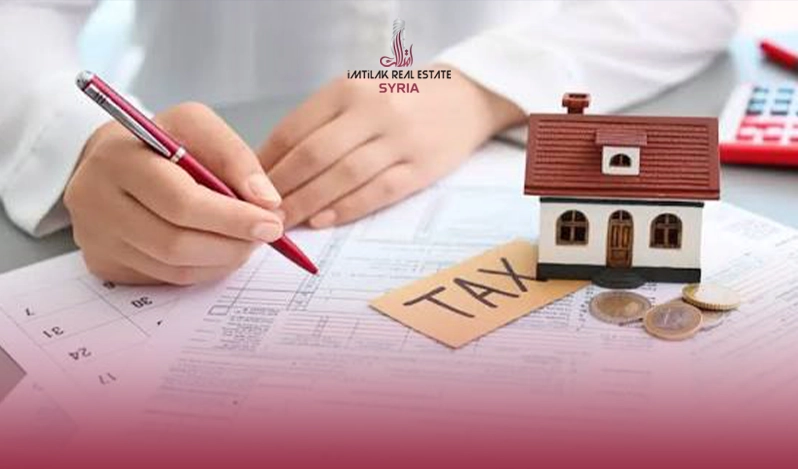


Choose the property that matches your lifestyle

Whether you are planning to buy a property, sell a home, or invest in a real estate project, knowing real estate taxes in Syria has become an essential step before making any decision. The costs are not limited to the price of the property only, but also include a set of taxes and fees that vary depending on the type of property and the nature of the transaction. In this guide, we review the most important real estate taxes applied in Syria based on the current legislation, the cases that require payment, and the main exemptions officially stipulated.
- What Are Real Estate Taxes in Syria?
- Types of Real Estate Taxes in Syria
- Who Pays Real Estate Taxes in Syria?
- How Are Property Taxes Calculated in Syria?
- Real Estate Tax Exemptions in Syria
- Real Estate Taxes vs. Property Transfer Fees
- How to Avoid Property Tax Mistakes in Syria
- Get Professional Real Estate Advice in Syria
What Are Real Estate Taxes in Syria?
The real estate tax is a mandatory financial amount imposed by the legislator on a legal event related to the property, such as its sale, transfer of ownership, or generating income from renting, and is collected for the benefit of the public treasury without a direct service in return. As for the fee, it is an amount paid in exchange for a specific administrative or governmental service, such as registration fees in the real estate registry. The real estate tax is imposed upon the occurrence of the event specified by law itself: sale contract, lease contract, or transfer of ownership by any means.
Types of Real Estate Taxes in Syria
Property Sales Tax in Syria
Property sales transactions in Syria are subject to the real estate sales tax regulated by Law No. 15 of 2021, which subjects both individuals and legal entities to this tax as an exception from the provisions of the Real Profit Income Tax Law No. 24 of 2003. The tax is imposed when the property is vacated (ownership transferred) at the real estate documentation offices, and taxpayers are required to submit a written declaration within thirty days of the event date, and pay the due tax within thirty days from the date of declaration.
The method of calculating this tax underwent a major change under the Ministry of Finance’s reform package implemented in July 2025, where the reliance on "market value" previously estimated by specialized committees was abolished, and replaced by the value agreed upon between the seller and buyer in the contract as the basis for tax calculation. The previously imposed bank deposit requirement for real estate sales was also canceled. All fees and additional charges accompanying the tax (local administration fee, reconstruction fee, stamp fee) were unified into a single tax and fee to simplify procedures. The Ministry of Finance also decided that cases of "withdrawal" (mutual agreement to cancel a sale before completing the ownership transfer) are not subject to any tax, and any paid amounts in such cases are refunded if applicable.
Regarding who bears this tax, the law does not explicitly require one party over the other, and the matter is usually left to agreement between the seller and buyer within the contract.
Is there a tax on selling property in Syria?
Yes, real estate sales tax is imposed according to Law No. 15 of 2021 and its 2025 amendments, and is currently calculated based on the value agreed upon between the seller and buyer in the sales contract.
Read more about: How to transfer property ownership in Syria
Property Ownership Transfer Taxes and Fees
Legally, no property ownership transfer is recognized unless it is documented and registered in the real estate registry. Law No. 15 of 2021 prohibits real estate registry offices and notaries from documenting or registering any real estate right unless the parties present a "clearance certificate" from the relevant financial departments, and any documentation contrary to this is considered void. After the 2025 reforms, the fees accompanying the registration process (local administration fee, reconstruction fee, contract stamp fee) have been merged into the unified real estate sales tax instead of being separate dues.
What is the difference between real estate tax and registration fees?
After the unification of fees in 2025, registration, stamp, and local administration fees became part of the single real estate sales tax, instead of being collected as separate dues as was previously the case.
Rental Property Taxes in Syria
Rented properties in Syria are subject to two types of tax obligations:
The first is the property and land yield tax, regulated by Legislative Decree No. 53 of 2006. This is an annual tax imposed on all types of buildings intended for use (residential, commercial, industrial) and on lands intended for construction within the zoning plan. It is calculated based on the "yield" of the property, i.e., the estimated rental value according to the decree, and is collected in one payment at the beginning of each year. Exemptions from this tax include certain cases such as residential properties and apartments whose annual yield does not exceed a certain legal limit.
The second is the actual lease contract tax under Law No. 15 of 2021 and its 2025 amendments, imposed when there is an actual documented lease contract. According to the July 2025 reforms, the rates are as follows: zero percent (0%) for residential properties rented to Syrians, 1.5% for residential properties rented to non-Syrians, 1.5% for lands within the approved zoning plan, and 2.5% for commercial (non-residential) properties. These rates include all accompanying fees and charges. These provisions exclude agricultural lands rented for agricultural investment purposes.
It should be noted that failure to declare a lease contract, or declaring a lower rent than the actual amount, exposes the taxpayer to the penalties of the Tax Evasion Law No. 25 of 2003.
Do taxes differ between residential and commercial properties?
Yes, commercial properties are subject to higher tax rates than residential properties for both sales tax and lease contract tax. Also, residential properties rented to Syrians are exempt from actual lease tax under the 2025 amendments.
Taxes on Real Estate Investment and Development
Profits of real estate companies and projects are generally subject to the Real Profit Income Tax Law No. 24 of 2003 and its amendments, and Legislative Decree No. 51 of 2006, which regulates the tax on a progressive basis up to high rates on net profits, with the possibility of reduction for projects subject to investment promotion laws.
As for specifically licensed real estate development and investment projects, they are exempt from real estate sales tax under Law No. 15 of 2021, and instead remain subject to the Real Profit Income Tax Law No. 24 of 2003 and its amendments. Successive investment laws (Law No. 18 of 2021 and its amendment Law No. 2 of 2023, and Investment Law No. 114 of 2025) provide tax and customs incentives for these projects, including exemption of imported building materials, finishing equipment, and service vehicles needed for project implementation from customs and financial fees, within certain relative ceilings of the estimated investment costs. Investment Law No. 114 of 2025 also provides for the possibility of granting an income tax exemption of up to 50% for ten years for projects established in developmental or specialized areas, according to criteria related to geographical location, sector, and employment size.
Are there tax exemptions for real estate development projects?
Yes, these projects are subject to a special tax regime under current investment laws instead of the regular real estate sales tax, with additional customs and tax incentives depending on the project’s classification and location.
Municipal Property Fees in Syria
There are municipal fees imposed on properties that vary by area and type of property, and are considered fees rather than taxes, as they are collected in exchange for municipal services related to the property and are determined by the relevant administrative units, unlike taxes which are imposed by general legislative text without direct service in return.
Who Pays Real Estate Taxes in Syria?
The party obligated to pay real estate tax varies depending on its type and the governing law:
- For real estate sales tax: The law does not specify a particular party, and the matter is usually subject to agreement between the seller and buyer.
- For property and land yield tax: The obligation is imposed on the beneficiary in areas registered in the real estate registry, on the actual owner, and on the possessor of constructions on public property.
- For lease contract tax: Imposed on the contractual relationship between the landlord and tenant depending on the type of property (residential or commercial) and the status of the tenant (Syrian or non-Syrian), but this does not necessarily mean that one party bears the actual payment burden, as this remains subject to agreement within the contract.
- For investment project tax: The obligation falls on the company or legal person licensed to practice development or real estate investment.
Who pays the real estate sales tax?
The law does not specify a particular party to bear the tax, and the matter is left to agreement between the seller and buyer, although it is common for the parties to negotiate sharing or assigning it to one of them.
How Are Property Taxes Calculated in Syria?
Calculating real estate tax depends on several factors determined by the current legislation, most notably:
- Type of property: Residential, commercial, industrial, agricultural, or land inside or outside the zoning plan, as tax rates vary according to this classification.
- Nature of the real estate transaction: Sale, gift, lease, or transfer of ownership by any other means, as each case has its own rules.
- Value adopted for calculation: After the 2025 amendments, the value adopted for sales tax is the value agreed upon between the seller and buyer in the contract, instead of the previously adopted "market value" estimated by financial committees.
- Current legislation at the time of the event: The provisions of the latest amendment in force at the time of the taxable event (sale, lease, etc.) are applied.
Real Estate Tax Exemptions in Syria
The Ministry of Finance’s 2025 amendments stipulated a set of exemptions from real estate sales tax for social and public interest considerations, most notably:
- Gift and lending between ascendants, descendants, and spouses.
- Transfer of property ownership from a partnership to a corporation.
- Lease contracts for residential properties rented to Syrians and similar cases, which are now subject to a zero percent tax rate.
- Cases of withdrawal (mutual agreement to cancel a sale before completing the ownership transfer), which are now not subject to any tax.
Current investment laws (most recently Law No. 114 of 2025) also grant special tax and customs exemptions and reductions for licensed real estate development projects, according to the project’s location and classification, as previously explained.
Are there exemptions from real estate taxes?
Yes, most notably exemption of gifts between ascendants, descendants, and spouses, exemption of residential lease contracts rented to Syrians, exemption of withdrawal cases, in addition to special tax incentives for licensed real estate development projects.
Real Estate Taxes vs. Property Transfer Fees
|
Criterion |
Real estate tax |
Fee |
|
Legal basis |
Imposed by general tax legislation (such as Law 15 of 2021 or Decree 53 of 2006) |
Collected in exchange for a specific administrative or governmental service |
|
Collecting authority |
General Authority for Taxes and Fees/Financial Departments |
Registration and documentation offices or relevant administrative units |
|
Reason for payment |
Occurrence of a specific legal event (sale, lease, property yield) |
Performing a specific service such as registration or documentation |
|
Nature of the rate |
Varies depending on the type of property and transaction |
May be fixed or relative fees depending on the service |
|
Example |
Real estate sales tax, property yield tax |
Municipal fees on the property |
How to Avoid Property Tax Mistakes in Syria
- Check the legal status of the property by requesting a recent real estate registry statement to ensure it is free of any mortgages or seizures that may affect tax obligations.
- Ensure financial clearance before signing, as no real estate right can be documented without this document according to Law No. 15 of 2021.
- Keep all receipts and documents related to payment of taxes and fees, as they are legal proof in any subsequent dispute.
- Officially declare lease contracts to the competent authorities to avoid tax evasion penalties.
- Consult a legal expert before completing any transaction, due to the numerous recent legislative amendments and their direct impact on the due tax value.
Get Professional Real Estate Advice in Syria
Buying or selling property is an important financial decision, so seeking the help of an entity with extensive experience in the Syrian real estate market will help you complete the transaction with confidence and clarity. The Imtilak Real Estate team accompanies you throughout the various stages of purchase or sale, starting from selecting the right property and providing real estate consultation, clarifying procedures and requirements related to the transaction, to coordinating the completion of ownership transfer procedures. If you are planning to buy, sell, or invest in property in Syria, the Imtilak Real Estate team is ready to help you make a well-informed real estate decision that suits your goals and needs. Contact us via WhatsApp to get a real estate consultation and answers to all your inquiries before making your decision.
Do you like this topic? You can share it with your friends now!


Do you like this topic? You can share it with your friends now!
More From Imtilak

Legal affairs in Syria
Removal of Common Ownership in Syria: Methods, Procedures, and Division of Property Among Partners



Legal affairs in Syria
Real estate signs in Syria: their types and impact on property

Legal affairs in Syria
What Is the Difference Between a Title Deed and a Land Registry Record in Syria?