What is the difference between the value of the property and the value of the land it is built on?
2026-09-26
381 common.blog.views


common.abyat_banner.title_2

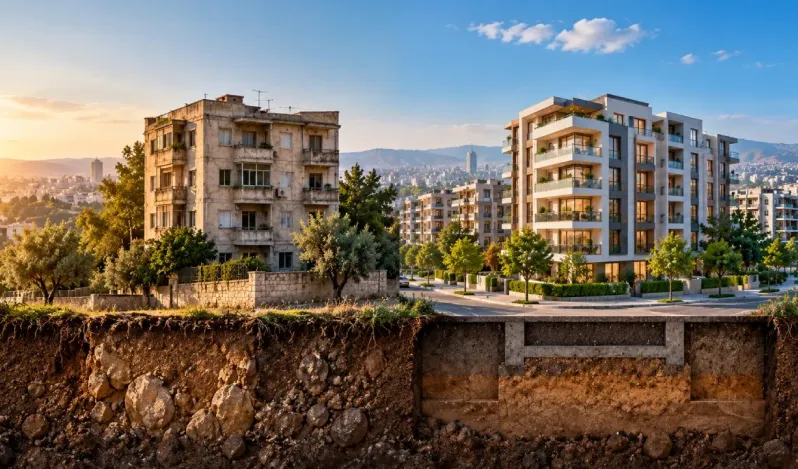
Two properties may be similar in area, building age, and finishing level, yet one may be priced significantly higher than the other. You may also come across an old building in need of maintenance, but its price is higher than that of a newer building in another area. In many cases, the reason is not in the walls and finishing, but in the land on which the property is built, its location, and its surroundings. Over time, the attractiveness of the location may increase, while the building itself ages and requires more care.
So, what are we actually buying when we purchase a property: the land, the building, or both?
- What makes up the value of a property?
- Land value
- Building value
- What is the difference between land value and building value?
- Why might land value rise while the building depreciates?
- Does land value always increase?
- Location may make the land more valuable than the building itself
- Why might an old property be expensive despite the age of the building?
- How does land value factor into the price of an apartment in a shared building?
- Does the apartment owner own a share of the land?
- Why do two similar apartments have different values if they are in different locations?
- What is the relationship between construction cost and property value?
- What happens to land value when the surrounding area develops?
- Land inside the city or on its outskirts: where is the value?
- When does land value become more important than building value?
- When the building is very old
- When the property is in a rare location
- When the land has great development potential
- When the nature of the area changes
- When the current use is less valuable than the property's future potential
- And when does building value become a main factor in the price?
- Is buying land better than buying a built property?
- How to assess property value before making a purchase decision?
- Choose your property based on value, not just price
- Consult Imtilak Real Estate before buying property
What makes up the value of a property?
The value of a property does not come from a single element, but from a group of intertwined factors that are difficult to separate completely: the land and its location, the building constructed on it, the rights associated with the property according to its legal and regulatory status, as well as the market situation and supply and demand in the area. Therefore, property valuation is an analytical process, not a simple arithmetic sum of separate figures.
Land value
The value of land is linked to factors unrelated to what is built on it, most notably: location and accessibility, area and shape of the plot, regulatory status and permitted use, available services and infrastructure, and the scarcity of similar land in the area. A serviced, regulated plot close to activity centers will have a fundamentally different value from a plot of the same size in an area lacking services or surrounded by regulatory issues.
Building value
The value of the building relates to the structure itself: the age and structural condition of the building, quality of construction and materials used, finishing level and design, area and room distribution, facilities such as elevators, heating and insulation systems, as well as the level of maintenance the building has received over the years.
Does property value equal the price of the land plus construction cost? Not necessarily. The cost of the land and building helps to understand the components of the property, but the market price is also affected by location, supply and demand, the condition of the property, its legal status, and buyer interest. That is why two properties with similar construction costs may sell for very different prices.
This is clearly seen when browsing properties for sale in Syria; you will notice that price differences are not explained by area alone, but are distributed among location, building age, property type, and demand level in each area.
What is the difference between land value and building value?
The difference can be summarized as: land represents "the place and its potential," while the building represents "the existing structure." The following table highlights the main differences:
Element | Land value | Building value |
What does it represent? | Location, rights, and usage potential | The structure built on the land |
Age | The land itself does not deteriorate like the building | Affected by age and use |
Maintenance | Does not require maintenance in the structural sense | Requires regular maintenance and renewal |
Location | Main factor in determining value | Cannot be completely separated from its location |
Scarcity | Affected by the availability of similar land | New similar buildings can be constructed |
Change over time | May rise or fall | The physical part may decline with age |
The last row is the most important: land value is not fixed nor does it move in a single direction, but rather changes according to location, demand, and regulatory and economic conditions.
Why might land value rise while the building depreciates?
This is the key paradox in understanding property value. Land does not undergo physical wear and tear in the way a building does. The building, on the other hand, gradually ages: plumbing and electrical systems need renewal, elevators require maintenance or replacement, facades and insulation need repair, and finishing needs updating. In addition, buyer preferences themselves change; a design that was desirable decades ago may not meet today's expectations in terms of space distribution, lighting, or amenities.
In contrast, land may become more attractive over time due to improved access to the area, the opening of new services, development of the urban fabric, a decrease in available land, or increased commercial and residential activity around the location. Thus, the two components of the property may move in opposite directions: a building losing part of its physical value, and land gaining additional appeal.
Does land value always increase?
No. Land value may decline or remain stagnant for several reasons, including reduced demand in the area, weak services, regulatory issues, changes in the nature of the area, or an increase in the supply of similar land. Therefore, land should not be treated as an asset guaranteed to appreciate, but rather as an element whose value is determined by its location and market conditions.
Location may make the land more valuable than the building itself
In some cases, the location becomes the heaviest factor in the property's price, even exceeding the value of the building itself. Imagine an old building on a plot of land in a high-demand area, close to services, markets, and transportation networks, versus a newer building in a less desirable area with weaker services. It is not surprising that the old property may have a higher market value, because what distinguishes it cannot be replicated: its location.
This is related to a broader concept discussed in the article The impact of property location on its value, where the issue is not limited to the city or district, but extends to the property's location within the area itself and its proximity to main streets and services.
Why might an old property be expensive despite the age of the building?
Because the buyer is not only paying for concrete and finishing, but also for the location, land, accessibility, existing services, scarcity of similar alternatives, and the rights associated with ownership. When these factors are strong, they can compensate for much of the impact of the building's age on the price.
How does land value factor into the price of an apartment in a shared building?
Many buyers ask a logical question: "If I buy an apartment on the fifth floor, I didn't buy land, so why is my apartment's price affected by the land value?"
The answer is that the apartment is not a unit suspended in space; it is part of a building constructed on a specific plot of land, in a specific location, and its owners share common elements such as foundations, entrances, roofs, and elevators. Therefore, the value of the location and land is reflected in the price of every apartment in the building, even if the owner does not have a separate plot registered in their name.
Does the apartment owner own a share of the land?
According to Article 811 of the Syrian Civil Code issued by Legislative Decree No. 84 of 1949, owners of building floors or apartments, when there are multiple owners, are considered partners in the ownership of the land and the parts of the building intended for common use, unless the land registry states otherwise. The article stipulates that these common parts cannot be divided, and each owner's share is proportional to the value of their unit, and they cannot dispose of this share independently of their apartment.
In other words, by default, the apartment owner is a partner in the land with a share linked to their apartment, but this share is not a separate part that can be sold individually. Since the rule allows for exceptions in the land registry, checking the property's official record remains an essential step before purchase. You can learn more about this in our guide on property ownership and title deed in Syria.
Why do two similar apartments have different values if they are in different locations?
Suppose there are two apartments, each 120 square meters, in buildings of similar age, with similar finishing and the same number of rooms.
The first apartment is in a high-demand area, close to schools, markets, and transportation networks, with few vacant plots available for construction, making similar alternatives limited.
The second apartment is in a less active area, with a large supply of similar apartments, and services are further away or less diverse.
On paper, the two apartments are almost identical. But in the market, their prices are likely to differ significantly. This shows that the property price cannot be explained by the equation "building price per square meter × area," because a significant part of the value comes from the land, location, and demand, not just the structure.
What is the relationship between construction cost and property value?
It is essential to distinguish between two concepts that many people confuse: construction cost and market value. Construction cost is what is actually spent on materials, labor, and equipment, while market value is what buyers are willing to pay for the property under current market conditions.
Two properties may cost almost the same to build, but their market values may differ drastically due to land, location, and demand. To understand the components of construction spending, you can refer to our guide on construction costs in Syria.
Does a higher construction cost mean a higher property value by the same amount? No. Construction cost is an influential factor in property value, especially in new buildings, but it does not determine the market price alone. The market also considers location, demand, property condition, and available alternatives, and the price may not reflect the full construction cost if the location has weak demand.
What happens to land value when the surrounding area develops?
When an area develops, the factors determining land value there change. New roads make access easier, opening schools, health centers, and markets increases residential appeal, launching residential and commercial projects brings in residents and activity, and as occupancy rises, demand for services and shops grows, and urban expansion may extend toward the area.
We have discussed this process in detail in the article How a new residential area becomes a fully integrated real estate center.
However, it is important to emphasize that urban development may positively affect land demand, but it does not guarantee an increase in value. Projects may be delayed, supply may exceed demand, or services may not arrive as expected.
Land inside the city or on its outskirts: where is the value?
The issue is not which option is better, but rather the different sources of value and risk in each.
Within built-up areas, land derives its value from scarcity, existing services, and known demand. Here, the buyer knows what they are getting, but available plots are few and prices are often relatively high.
In expansion areas and on city outskirts, land value comes from available space, development potential, and possible future projects, with a higher degree of uncertainty about the speed of service arrival and demand growth.
If you are considering this option, our guide on buying land for construction in Syria helps you understand the regulatory and practical aspects you need to review before making a decision.
When does land value become more important than building value?
The weight of land increases in property valuation in certain cases, most notably:
When the building is very old
The older and more deteriorated the building, the greater the share of the property's value that comes from the land and location rather than the structure.
When the property is in a rare location
Locations that are hard to find alternatives for, such as properties overlooking main streets or in fully serviced neighborhoods, give the land a greater weight in the price.
When the land has great development potential
If the land's regulatory status allows for broader uses than currently exist, this may be reflected in its valuation.
When the nature of the area changes
The transformation of a quiet residential area into a commercial hub, or vice versa, may reshape the land's value.
When the current use is less valuable than the property's future potential
This happens when the existing property is less than what the location allows, but benefiting from this depends on regulatory systems and valid building permits, and should not be assumed without verification.
And when does building value become a main factor in the price?
The above does not mean that the building is always secondary. In many cases, the building is a main part of the value, especially in modern residential projects, new buildings with good construction, properties with high-quality finishing, complexes offering shared services such as parking, security, green spaces, and buildings equipped with modern insulation, energy, and elevator systems.
In these cases, the buyer pays for the property's readiness and savings on maintenance and renewal costs in the early years, which explains why a large segment of buyers are interested in modern residential projects offered by Imtilak Real Estate.
Is buying land better than buying a built property?
There is no single answer to this question, as the best option depends on the buyer's goal:
If the buyer's goal is | What needs to be evaluated? |
Immediate housing | A built property may be more practical |
Private construction | The land, possibility of building on it, and its regulatory status |
Development | Regulations and land utilization potential |
Near-term income | Ready-to-use or rentable property |
Long-term holding | Location, demand, costs, and risks |
The decision ultimately depends on the goal, budget, available time, and the buyer's willingness to handle the stages of construction and manage its risks.
How to assess property value before making a purchase decision?
Instead of just asking "What is the property price?", try asking the following questions when comparing options:
How much of this property's value comes from the location?
What is the building's condition and age, and what maintenance is expected?
How scarce are similar land and properties in the area?
What is the property's regulatory and legal status as shown in the land registry?
What changes are expected in the area in the coming years?
What is the demand for this type of property specifically?
Is the price due to building quality, location strength, or both?
Answering these questions will not give you a final number, but it will help you understand what you are actually paying for.
Choose your property based on value, not just price
The price is the number the seller asks for, while the value is what the property actually represents in terms of land, building, location, rights, and market demand. Two properties may seem similar in price, but differ in the source of their value: one derives its value from a modern building in an average location, the other from a prime location despite an old building. Understanding this difference makes your purchase decision more informed, whether your goal is housing or investment.
Consult Imtilak Real Estate before buying property
When comparing properties, it is not enough to look at the area or the asking price alone; a significant part of the property's value may be linked to the land's location and the nature of the area, while another part is related to the building's age, quality, and condition. The Imtilak Real Estate team helps you compare available options and understand the characteristics of the property and area before making a purchase decision.
common.blog.share_article


common.blog.share_article
common.blog.more_imtilak